ESG and sustainability trends for the chemicals industry in 2026

As one of the world’s largest greenhouse gas emitters, the chemical industry plays a pivotal role in the global sustainability and ESG transition. Ellen van der Linde, Climate Analyst at Nexio Projects, shares five ESG trends set to shape the sector in 2026
1: Tackling Scope 3 emissions across the value chain
The chemicals industry ranks among the highest industrial emitters, with Scope 3 emissions accounting for approximately 75% to 90% of total greenhouse gas emissions, driven largely by upstream raw material production and downstream product use and disposal. Key contributors across the sector include:
- Energy-intensive production of chemical intermediates, such as acids, alkalis, solvents, and industrial salts.
- Embedded emissions from purchased feedstocks and utilities, particularly in processes such as chlor-alkali production, ammonia derivatives, and industrial gas supply.
- End-of-life treatment of sold products, including wastewater discharge, neutralisation, or incineration of chemical residues.
Growing regulatory and investor focus on full value chain transparency and achieving net zero is pushing chemical companies to engage suppliers on emissions reporting and collaborate on lower-carbon sourcing strategies. Industry initiatives such as the Together for Sustainability (TfS) framework support improved data consistency and supplier comparability, accelerating progress from compliance to emissions reduction and sustainability leadership.
Distribution of emissions in the chemicals sector
In the chemicals industry, a large share of Scope 3 emissions often comes from Category 1: Purchased Goods and Services, due to the carbon-intensive production of feedstocks, solvents, and other intermediate chemicals. A significant portion can also arise from Category 12: End-of-Life Treatment of Sold Products, reflecting downstream impacts when products are disposed of, frequently through emissions-intensive methods such as incineration.
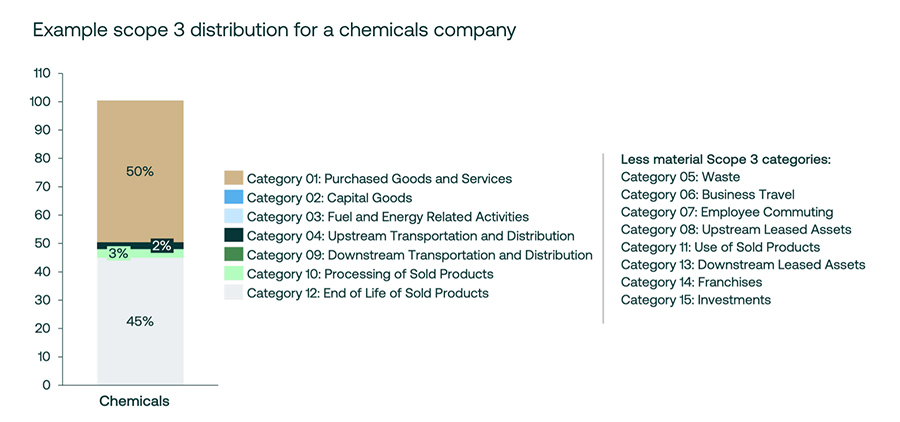
Smaller but still relevant contributions typically come from Category 4: Upstream Transportation and Distribution and Category 10: Processing of Sold Products, linked to logistics and how customers further process chemical intermediates. This distribution is indicative for the sector but can vary for companies with specific product portfolios and business models.
2: Advancing circularity in specialty chemicals and plastics
Circularity is increasingly redefining chemical production by reducing reliance on virgin raw materials, improving resource efficiency, and minimising waste across processes and product lifecycles. Key circular strategies include:
- Recovery and reuse of solvents, acids, and bases through closed-loop processing systems.
- Recycling and purification of inorganic salts and intermediates for reintegration into production.
- Designing formulations for recyclability, biodegradability, or safe neutralisation, particularly in coatings, detergents, and industrial cleaning applications.
Recent industry analysis highlights urgent actions to scale circularity, including improved waste segregation, eco-friendly product design, process optimisation, and supportive policy frameworks to enable recycling infrastructure. Strengthening circular practices not only reduces environmental impact but also enhances supply security and cost resilience across chemical value chains.
3: Navigating chemical-specific regulatory frameworks
Chemical companies operate within an increasingly complex regulatory environment addressing emissions, hazardous substances, and product safety, with major policy developments reshaping compliance expectations across markets. Key developments include:
- CSRD / ESRS, mandating enhanced disclosures on chemical pollution, water emissions, biodiversity impacts, and human rights risks across value chains.
- CBAM, introducing carbon cost exposure for energy-intensive chemical products and intermediates.
- REACH and Chemicals Strategy for Sustainability reforms, tightening restrictions on substances of very high concern (SVHCs) and enforcing the principle of essential use.
As regulatory scrutiny intensifies, non-compliance can result in market access restrictions, while proactive alignment strengthens investor confidence and customer trust. Integrating regulatory requirements into ESG strategy is becoming a critical differentiator across the sector.
4: Strengthening product stewardship for hazardous substances
Beyond emissions, ESG performance in the chemicals industry increasingly depends on robust product stewardship throughout the lifecycle – from synthesis and formulation to downstream use and disposal
Main priorities include:
- Substitution of hazardous substances, such as persistent, bioaccumulative, or toxic compounds, with safer or bio-based alternatives where feasible.
- Improved traceability and inventory management, including preparation for Digital Product Passports for regulated substances.
- Supplier audits and due diligence, particularly for imported intermediates and substances subject to authorisation or restriction.
Effective product stewardship reduces environmental and health risks while mitigating legal and reputational exposure linked to legacy contamination and non-compliance.
5: Addressing climate risks in chemical operations
Chemical manufacturers face escalating physical and transition climate risks that threaten operational continuity and financial performance, from extreme weather disrupting production sites to rising carbon costs affecting energy-intensive processes.
Physical risks include flooding, heat stress on reactors and cooling systems, and water scarcity impacting processing and effluent treatment. Scenario analysis under different climate pathways indicates potential 10% to 20% revenue impacts from downtime, energy price volatility, or raw material disruptions in energy-intensive operations.
An overview of focus areas:
- Climate scenario modelling, aligned with TCFD principles, to assess impacts on assets, capex, and opex.
- Supply chain resilience, including diversification of critical inputs and stress-testing key suppliers.
- Adaptation measures, such as water recycling systems, heat-resilient infrastructure, and on-site renewable energy integration.
Organisations embedding climate risk management into ESG strategy are better positioned to safeguard operations, manage transition risks, and capture value from increasingly climate-resilient product offerings.
Conclusion
The chemical sector faces mounting environmental pressures, evolving regulatory demands, and heightened stakeholder expectations. Companies in the sector must undergo a holistic ESG transformation to remain competitive – addressing its extensive emissions, hazardous substances, and resource inefficiences. Understanding these ESG trends, and acting decisively, will them to take the lead in sustainability.