European competitiveness may be making a comeback, says Roland Berger

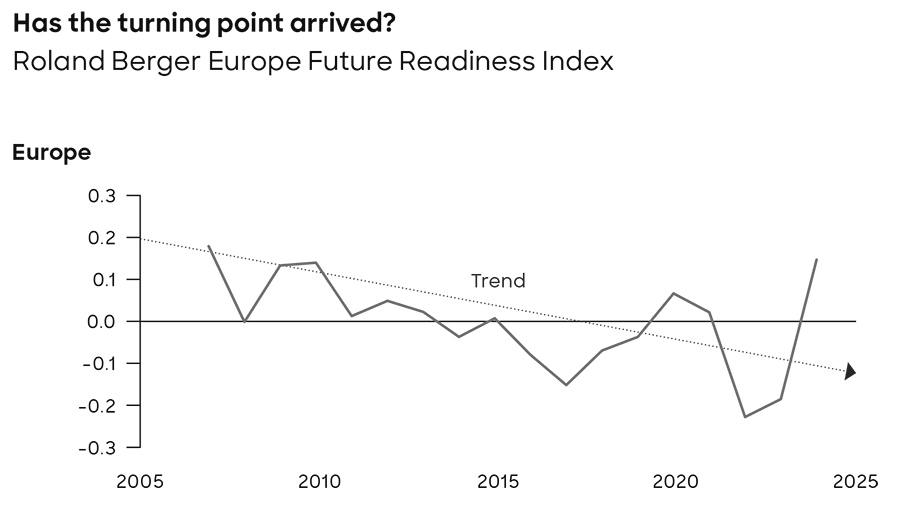
Europe is approaching a critical turning point as it attempts to reinvent the regional economy. While the continent faces pressure from high energy costs, regulatory burdens and an ageing population, a new report from Roland Berger suggests that its underlying strengths still provide a solid competitive edge.
Following a period of lagging behind, Europe now faced the need to reinvent its economy. Despite being overshadowed in industry and innovation by other regions, underestimating Europe’s strengths would be a mistake. It is still the world’s second-largest consumer market and boasts a diversified and resilient industrial base.
For example, Europe currently produces more than a quarter of the world’s science and technology graduates and generates 14% of its economic output from manufacturing. This is significantly higher than the 10% share seen in the United States.
The Roland Berger report tracks progress across six areas: People, infrastructure, institutions, green energy, technology, and stability. After years of decline, the data from 2024 shows that momentum is finally beginning to improve. Growth is particularly strong in the areas of green energy and security.
Among the various case studies highlighted by the report is Poland, which has managed an impressive economic makeover in recent years, driven by a strong labor market and impressive GDP growth of over 3%, higher than most major EU economies. Switzerland and Spain have also been able to capitalize on innovation, industry, and economic diversification.
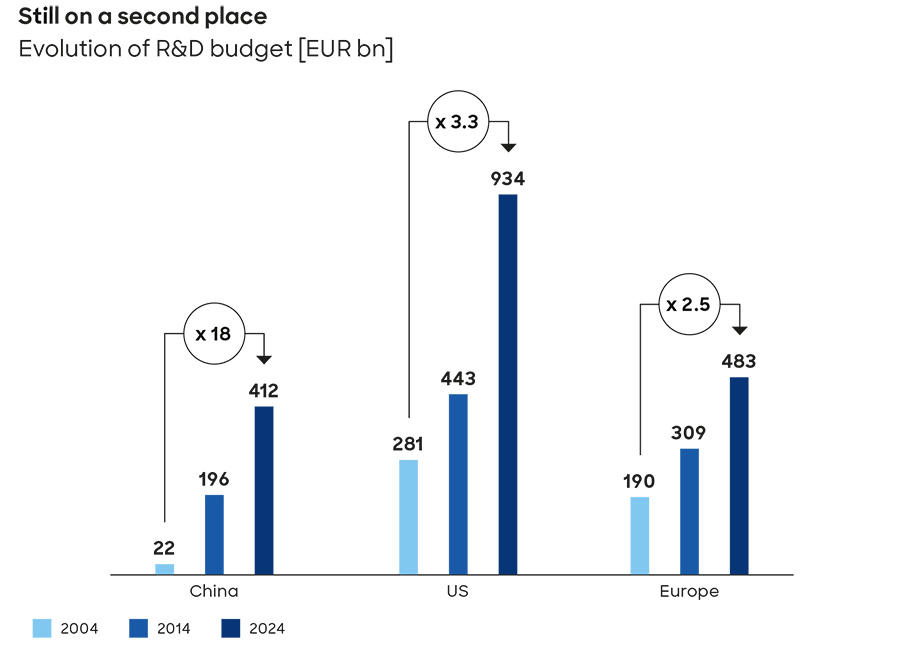
Europe has lost ground to the US in most areas, and research and development (R&D) is no exception. When compared to China, spending in R&D in Europe grown more slowly over the past two decades but remains high in absolute terms: €483 billion compared with China’s €412 billion. That gap may have narrowed, but it hardly signals decline.
A focus on defense
Nowhere is Europe’s reinvention more evident than in the defense sector. For example, European defense spending is expected to reach €180 billion by the end of 2025. This represents a total that is more than double the amount spent in 2021.
The European trend towards defense sovereignty was pushed into overdrive after the first Trump administration began to signal it would step back from its leading role in NATO. Now in the second Trump administration as that retreat from NATO has only increased, European nations are scrambling to build up their defense capabilities even more.
“With Europe going all in on tailored investments, it can meet security and climate needs while driving new industrial growth,” said Ina Wietheger senior partner at Roland Berger.
“Europe is still all in on powerful assets: Deep talent, a robust industry, and leading research. With aligned capital, regulation, and industrial strategy, renewed competitiveness is within reach,” said David Born, head of Roland Berger Institute.
Catching up on innovation
Despite these gains, the report warns that Europe is still falling behind in innovation. European startups often struggle to grow because they lack the same access to funding as their competitors.
On average, American startups raise three times more money than those in Europe. To fix this, experts suggest that Europe must simplify its regulatory frameworks and make it easier for private savings to be invested in new businesses.
The AI Action Summit, held last year in Paris, was a symbolical moment for European tech and the prevailing regulations. While much of the programming was aimed at questions of safety and risks, perhaps the most memorable moment was U.S. Vice President JD Vance’s speech, in which he all but declared victory in the ‘AI race’ against his European counterparts, who he portrayed as tied up in red-tape. It served as a wake-up call for many EU leaders.
But while Europe may not lead in every area of technology, it has a massive amount of industrial data that could give it an edge in specialized AI. Leaders argue that by combining this data with better regulation and more investment, the continent can secure its future prosperity. The window of opportunity to act is small, but the foundation for a comeback is already in place.
“Europe’s future competitiveness will hinge on its ability to align energy affordability, digital progress, and institutional strength,” said Laurent Benarousse, senior partner at Roland Berger.
“As AI scales rapidly, access to low-cost, reliable energy becomes as critical as talent or data. This is the moment to recalibrate Europe’s strategic direction.”