The strategic significance of stablecoins in settlement

While stablecoins are currently best known from the crypto scene, they have the potential to become major players in the global payments landscape. Stefan Schnitzler, Senior Manager at Eurogroup Consulting, explains why stablecoins could deliver significant benefits and impact, particularly in settlements.
What are stablecoins?
Stablecoins are digital tokens whose value is linked to a reference asset – typically a sovereign currency such as the US dollar or the euro. Their objective is to combine the price stability of traditional currencies with blockchain-based infrastructure.
Unlike volatile crypto-assets such as Bitcoin or Ether, stablecoins are designed to maintain price stability. The dominant structure today is fiat-backed issuance, where reserves – such as government bonds or bank deposits – support the outstanding tokens.
Prominent examples include USDT (Tether) and USDC (Circle). Both are widely used in global trading, liquidity management, and increasingly in cross-border transactions. Traditional financial institutions are also exploring or implementing their own stablecoin structures.
Settlement infrastructure
Viewing stablecoins solely as a payment innovation underestimates their systemic relevance. Stablecoins in fact represent an alternative settlement infrastructure. And it is precisely at this level that the economically relevant effects of stablecoins materialize – in finality, liquidity allocation, and the economic control of transactions.
Sustainable economic impact in payments does not primarily arise at the customer interface. It emerges in settlement. Finality, liquidity allocation, risk distribution, and intermediary design determine who holds capital, who earns fees, and who absorbs structural dependency. Stablecoins operate precisely at this layer.
For banks, the primary question is therefore not whether to launch a stablecoin product. What matters is that an additional settlement architecture now exists. This new reference point influences liquidity binding, cost structures, risk allocation, and negotiation leverage – even if an institution does not issue a stablecoin itself.
Stablecoins affect balance sheets, treasury steering, and long-term structural dependencies. They redefine expectations regarding speed, finality, and intermediary design. In doing so, they directly touch core dimensions of financial management and strategic positioning in payments.
Payment versus Settlement
Understanding the strategic relevance of stablecoins requires a clear separation: payment is not settlement.
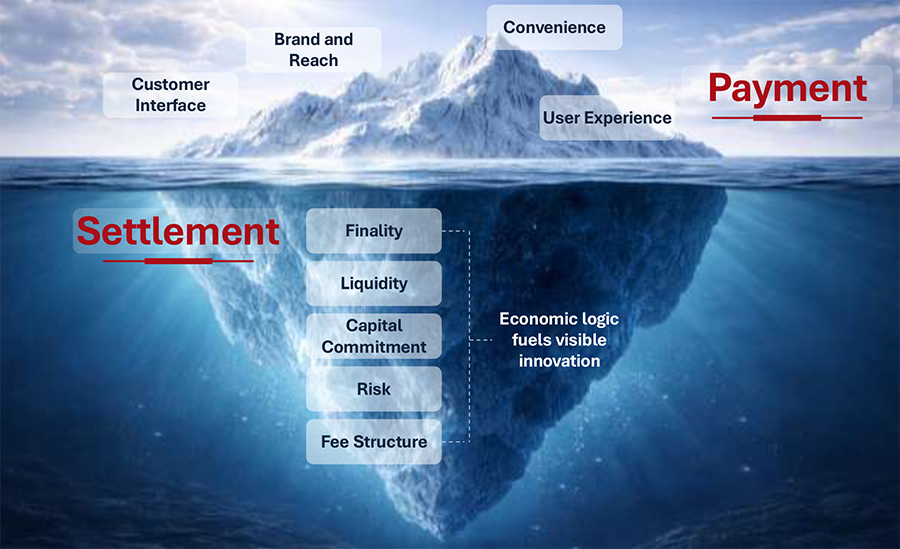
Payment concerns the initiation of a transaction. It involves customer interface, brand positioning, convenience, and reach. Control at this level can generate significant market power – particularly toward end customers. However, this power remains only indirectly monetizable and ultimately dependent on the underlying settlement structure.
Settlement determines when a transaction becomes final, how long capital remains tied up, how much liquidity must be maintained, and how risk is distributed. It is at this level that the most structural and durable revenues in payments are generated. Fees, interest margins, collateral requirements, and balance sheet metrics are shaped here.
Stablecoins do not primarily challenge payment. They alter the reference architecture of settlement. And altering the reference architecture changes the long-term economic logic of the market.
What stablecoins change systemically
Stablecoins are often evaluated based on their potential to become a dominant everyday payment instrument. This question is legitimate – but not decisive.
In economies with high inflation, capital controls, or fragile banking infrastructures, stablecoins can function as both payment and store-of-value alternatives. In such environments, they may partially substitute for trust in domestic currency or banking systems.
In mature markets such as Europe or the United States, the situation differs. Stable currencies and real-time payment systems (for example: SCT Inst) are already established. Stablecoins are therefore not primarily a speed argument nor a necessary checkout transformation. Their impact lies deeper – in structure.
SCT Inst enables rapid bank-to-bank transfers within defined regulatory and infrastructural frameworks. Stablecoin settlement follows a different logic: natively digital, potentially globally interoperable, and not inherently dependent on correspondent banking chains or centralized clearing layers. The issue is not seconds. It is architecture.
What does this mean?
First, liquidity logic shifts. Traditional cross-border payments rely on multi-layer correspondent networks, Nostro accounts, and pre-funding. Where stablecoin settlement provides an alternative, structural pre-funding requirements may decline. Even partial adoption can generate working capital effects.
Second, negotiation leverage evolves. Once an alternative settlement pathway exists, incumbent infrastructures are no longer without substitutes. Immediate volume shifts are not required for strategic impact. The credible option alone influences pricing, contractual dynamics, and dependency structures.
Third, programmability expands coupling potential. Tokenized assets and programmable logic allow tighter integration between payment and performance.
Even if stablecoins do not dominate payment flows in mature markets, they redefine the settlement reference framework. Institutions that ignore this shift base strategic decisions on assumptions that may no longer hold.
Comparing settlement architectures
The structural differences between traditional settlement and stablecoin-based settlement are clear:
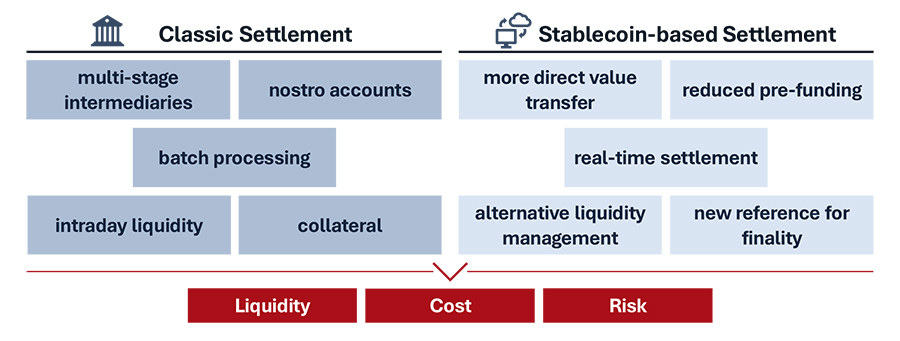
In traditional cross-border processing, value transfer typically passes through multiple correspondent banks. Each stage introduces account structures (Nostro/Vostro), liquidity buffers, and timing frictions. Capital is pre-positioned and risk is distributed across the chain.
In stablecoin settlement, value is transferred as a token via a blockchain network. Banks utilize on/off ramps to convert between bank deposits and tokenized value. Transfer occurs at network level before funds are reconverted into bank money on the receiving side.
Structurally, this implies fewer intermediaries, altered liquidity mechanics and a new reference point for finality. Not every transaction automatically becomes cheaper or simpler. However, the economic baseline against which decisions are evaluated changes.
Economic value levers: Liquidity, Cost, Risk
Innovation in payments is often assessed based on visible features. Economically decisive factors are different: How long is the duration of capital binding? What are the collateral requirements and the pre-funding intensity? How complex is exception handling?
Settlement is where these variables are determined. In traditional cross-border frameworks, multi-tier intermediary chains, Nostro holdings, intraday liquidity management, and collateral requirements bind capital and generate structural cost.
Stablecoins introduce an additional settlement option. Where value transfer can occur more directly, economic calculus shifts:
- Liquidity binding may decline.
- Fee layers may come under pressure.
- Counterparty and timing risks may be reassessed.
These effects do not require full migration. The credible availability of an alternative influences internal modelling and external negotiation. Stablecoins are therefore not a marketing narrative. They directly affect balance sheets, liquidity metrics, and cost structures.
Potential roles for banks
Stablecoins are neither a product experiment nor an isolated IT initiative. They concern infrastructure positioning – and infrastructure positioning shapes long-term revenue logic, capital intensity, and structural dependency. This is precisely why the question of stablecoins is a strategic one.
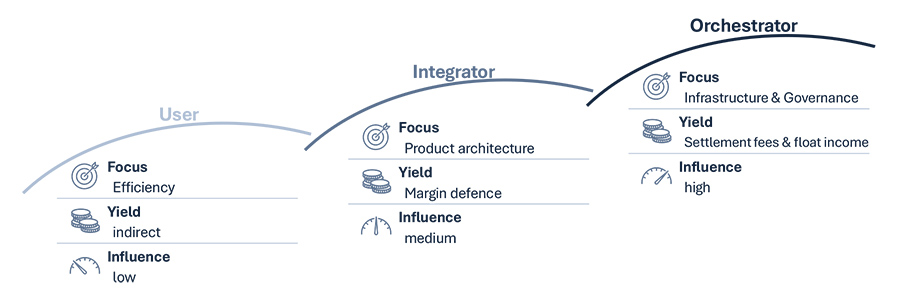
For banks, it is less a question of whether to use stablecoins and more a question of what role they want to play in a changed settlement architecture. From a strategic perspective, three basic roles can be distinguished. They represent different degrees of influence, responsibility and economic potential.
1) The user
In this role, a bank selectively employs existing stablecoin infrastructures for defined use cases – for example cross-border settlement, treasury optimization, or tokenized asset processing.
The focus is efficiency. Stablecoins serve as an additional settlement pathway to reduce liquidity binding, question pre-funding assumptions, or streamline intermediary chains. This role requires regulatory assessment, treasury adaptation, risk model adjustments, and partnerships with on/off ramp providers or custodians. It is operationally meaningful but strategically limited. The bank utilizes infrastructure without shaping it.
2) The Integrator
As an integrator, the bank embeds stablecoin settlement into its product architecture. Stablecoins become part of international payment solutions, platform services, or capital markets offerings.
The focus shifts toward margin defense and differentiation. Flexible settlement capabilities can stabilize existing revenues or enable new services. Dependence on external infrastructure often remains, but strategic design latitude increases.
This role requires compliance recalibration, risk framework adjustments, and deliberate use-case selection. The integrator strengthens competitive positioning without redefining the overall architecture.
3) The Orchestrator
The orchestrator shapes elements of the settlement infrastructure itself – alone or in consortium. This may include issuing a stablecoin, but more fundamentally it involves governance influence.
Issuance is increasingly modular. Technology, custody, and compliance components can be sourced externally. Strategic depth arises where influence over standards, liquidity design, and access rules is exercised.
Potential revenue sources include settlement fees, float income, and standard-setting advantages. Capital intensity and regulatory responsibility increase accordingly. The orchestrator does not merely participate in infrastructure – it shapes the reference model.
The implications
The choice of role is not a technological detail, but a strategic decision by management. This strategic decision affects and should condier three core areas of corporate management:
- Cost structure: liquidity binding, pre-funding, processing economics
- Revenue logic: float potential, service monetization, margin resilience
- Structural dependency: influence over infrastructure, governance, and market standards
Conclusion
Stablecoins are not an innovation budget topic. They are a decision about future infrastructure dependency and strategic optionality. The key question is not: Should we offer stablecoins? The key question is: Which role do we intend to play in a world where settlement becomes more optional, more global, and potentially less capital-intensive? This decision belongs on the corporate strategy agenda.