Czech organizations are progressing with AI – but data is holding them back

Companies in the Czech Republic are planning to invest further in artificial intelligence (AI) and scale their use of the technology this year, according to a study by Adastra. However, many organisations are finding that moving from early experimentation to large-scale deployment remains difficult.
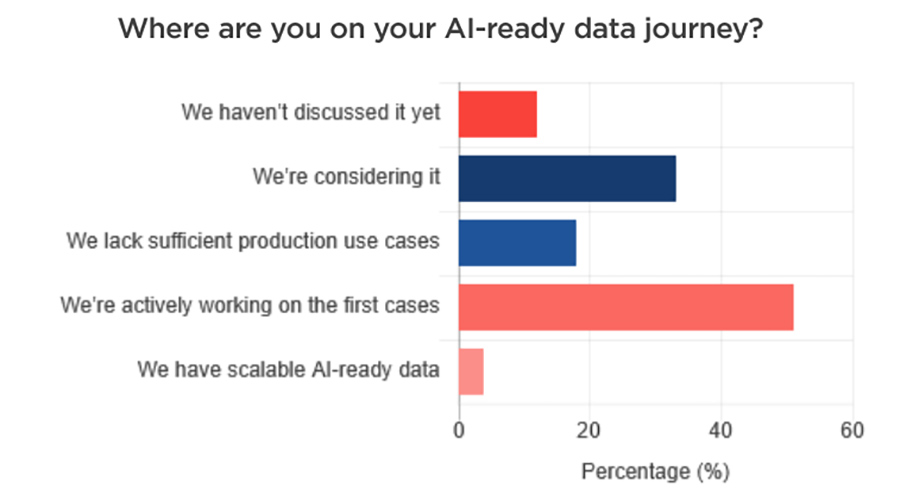
In Adastra’s survey of 80 senior executives from major Czech enterprises, more than half (51%) said their organisations are already working with AI. Most of these companies fall somewhere between the early stages – running initial pilots or testing use cases – and more mature adoption, where AI is being rolled out across departments or business processes.
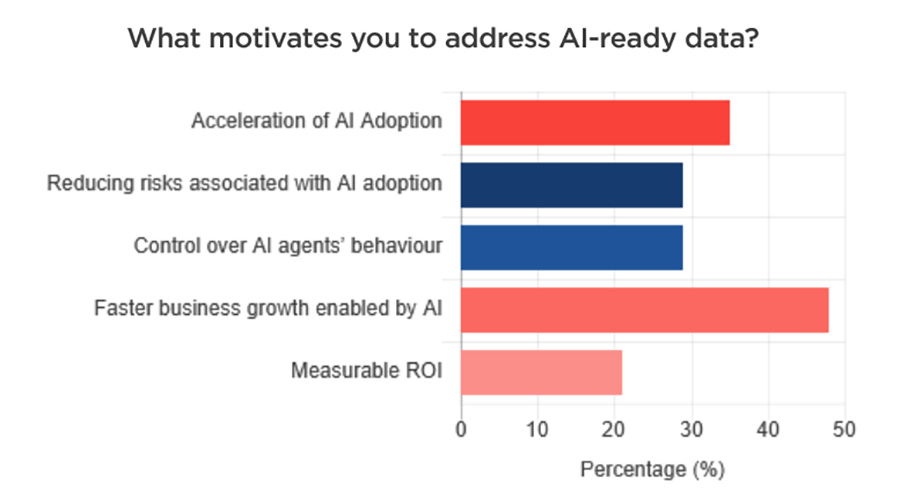
When asked about the benefits they expect from AI and generative AI, respondents most frequently pointed to direct business growth (48%). This was followed by improvements to operations and processes, as well as stronger risk management capabilities.
Scaling remains a challenge
Despite strong interest in adoption and scaling, the research shows that progressing from early experimentation to organisation-wide deployment is a significant challenge. Only a small number of companies have successfully scaled AI across their business. The survey estimates that roughly one third of organisations that have attempted to scale their AI initiatives have succeeded so far, suggesting that for many companies the journey is still in its early stages.
One of the bottlenecks leaders face is identifying production-grade use cases. Around 18% of respondents said they struggle to determine where AI can deliver the most value. Because AI can be applied across so many areas of the business, organisations must prioritise carefully and focus on use cases that are both feasible and strategically important – a process that many find challenging.
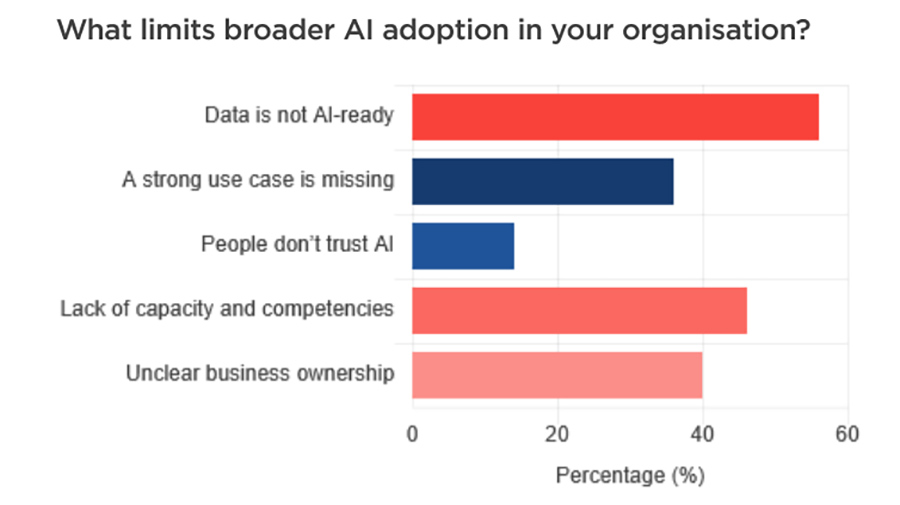
Another major obstacle is the lack of resources and specialised expertise needed to scale AI initiatives. As a relatively new field, AI requires highly specialised skills, and competition for talent remains intense.
The survey also found that 40% of respondents believe that scaling AI requires clear business ownership. Traditionally, large technology transformations have been led by the CIO. However, because AI can affect virtually every part of an organisation, it requires broader ownership from business leaders – something many companies are still trying to organise effectively.
The largest obstacle: data
Above all, however, data remains the biggest barrier to scaling AI. Only 4% of respondents said their organisation’s data maturity is sufficient to support large-scale AI deployment. The majority of companies (56%) reported that their data is not yet accurate, complete or sufficiently AI-ready to support wider adoption.
“The survey shows that Czech companies are ready to adopt AI and recognise its value. The next step is to ensure high-quality, trustworthy data – only then can they build AI services that scale safely and effectively,” said David Kaláb, Vice President at Adastra. “Without high-quality data and a clear data strategy, AI projects struggle to move beyond the pilot stage,” he added.
The survey included leaders from several sectors, including financial services, telecommunications, retail, insurance, manufacturing and automotive, energy and utilities, and the public sector.
Headquartered in the Czech Republic and Canada, Adastra employs more than 2,000 people across Europe, North America and Asia. The company is backed by private equity firm The Carlyle Group.