
Gen AI in procurement is shifting from broad experimentation to more high-impact areas


Procurement organizations across Europe are moving away from broad generative AI (Gen AI) experimentation toward a “selective industrialization” focused on high-impact, proven use cases. That is according to the 2026 CPO Annual Pulse Report from EFESO Management Consultants.
Despite a high level of awareness about the value of integrating Gen AI tools with procurement processes, widespread adoption has remained stalled by structural barriers like poor data quality, a significant skills gap, and the need for clear economic return.
The report from EFESO Management Consultants indicates that the hype surrounding AI in procurement is giving way to a more practical focus on value and feasibility. According to the survey of over 50 chief procurement officers across Europe, it is clear companies are shifting away from broad experimentation and toward a more selective use of these tools in specific high-impact areas.
A persistent digital divide
Many organizations seem to be holding off on launching AI initiatives. A total of 53% of procurement leaders report plans to launch new Gen AI projects in 2026, while 33% remain in a wait-and-see position. In addition, 14% do not plan to invest at all.
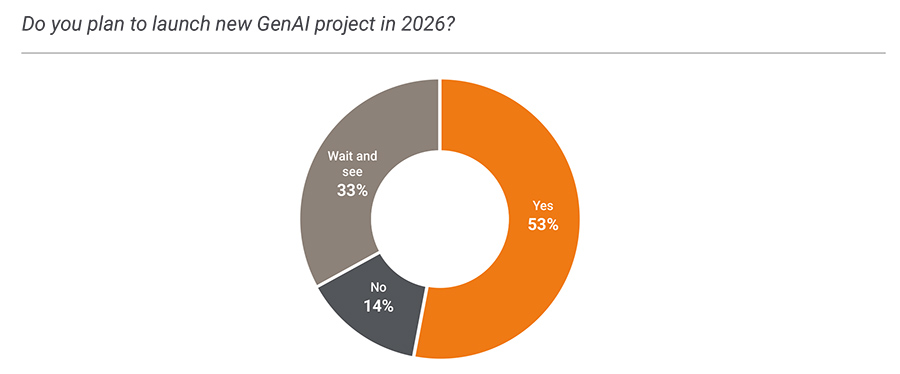
“This distribution confirms that Gen AI has secured executive attention, but it has not yet become a default investment lever within procurement,” said Marc Irmler, manager at EFESO Management Consultants.
The vast majority of executives, employees, and the wider public understand the usefulness of AI tools and have used them already. The report shows awareness is already very widespread.
However, the data shows that while 93% of executives have used Gen AI at least once, only 5% of organizations have achieved widespread adoption. Most companies remain in a learning phase, with 75% currently exploring the technology or running small-scale tests.
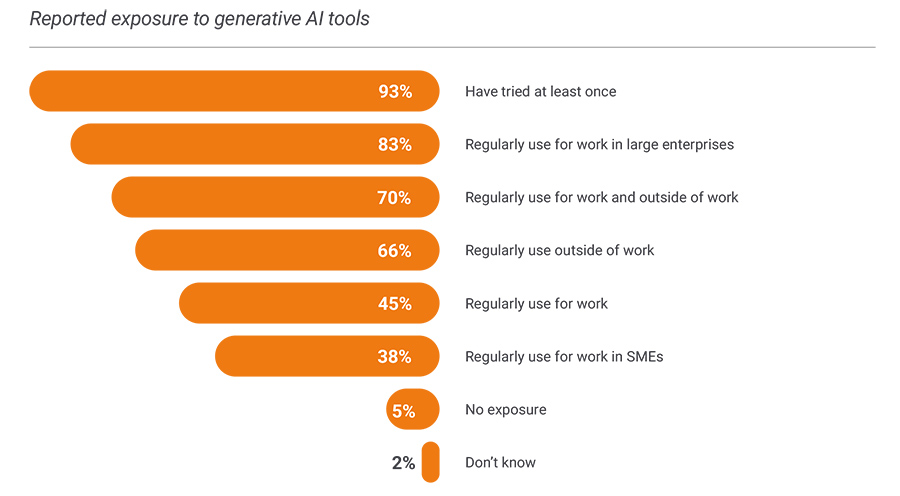
Large enterprises are leading the way, with 83% using these tools regularly for work, compared to only 38% in small and medium-sized businesses. This digital divide is often caused by differences in available budgets and training.
“The challenge is not simply access to a chatbot or license,” said Laurent Coulon, senior partner at EFESO Management Consultants. “It extends to ergonomics, data quality and relevance, data security, governance, human support, and the ability to redesign processes around these technologies.”
Companies expect more value
Business leaders are now looking for clear evidence of financial return before investing, forcing AI initiatives to compete for funding with traditional cost-saving or innovation measures. This shift is reflected in satisfaction levels, as only 34% of respondents say they are fully satisfied with the value delivered by their AI projects so far.
Currently, the most common uses for generative AI involve processing text. Approximately 69% of organizations use the technology for contract analysis and summaries, while 61% use it for market intelligence, and 55% for automating requests for proposals.
These use cases primarily provide productivity gains. For 66% of high-performing organizations, efficiency is the main goal, far ahead of other benefits like improved negotiations at 35% or risk reduction at 7%.
“This productivity‑first trajectory is both intentional and rational. Organizations prioritize use cases that are faster to deploy, easier to adopt, and lower risk,” said Raphaël de Saint Vincent, consultant with EFESO Management Consultants.
“By contrast, strategic and performance-oriented value remains secondary at this stage, not because it is less important, but because it is structurally more complex.”
Skills and data are key bottlenecks
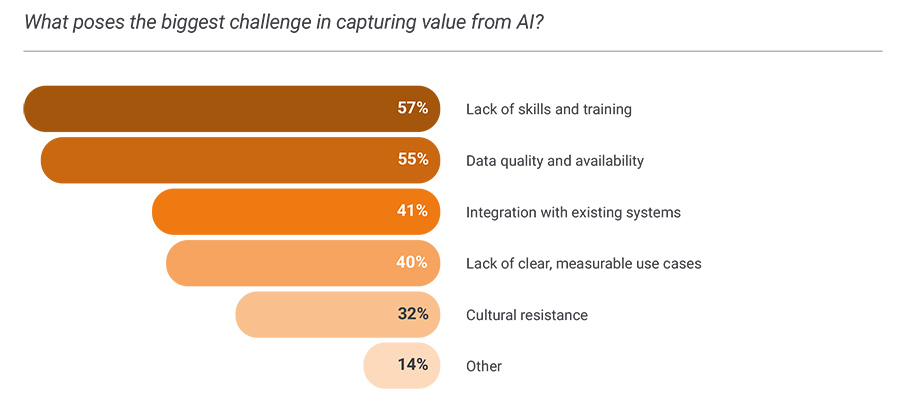
Significant challenges still linger for many companies when it comes to adopting AI more broadly. The biggest obstacles are a lack of skills and training, cited by 57% of respondents, and poor data quality, the biggest problem for 55% of those surveyed.
In addition to that, 68% of respondents expressed concerns about the reliability of information and the tendency for AI to produce inaccurate results (hallucinations), while 67% cited worries regarding data privacy and legal compliance, which are also significant risks.
Despite some of the obstacles, experts suggest that 2026 will be a year of strategic clarity rather than universal deployment. Success will depend more on human capability and data quality than on the technology itself.
“Procurement leaders who treat Gen AI as a value engine, not a technology experiment, will convert early wins into sustainable performance,” the report concludes.
“The transition from hype to reality is underway, and the competitive gap will widen between those who scale selectively with purpose and those who remain in perpetual pilot mode.”